Imagine waking up and finding your native tongue has vanished, replaced by a language you haven't spoken since childhood or even a strange new accent. Although these cases are rare, they offer scientists a unique window into how language is organized in the brain. For people with aphasia, a condition that affects the ability to use or understand language, such unexpected changes can become a reality after brain injury. This article focuses on aphasia caused by sudden brain injuries, such as strokes or head trauma, where language abilities may gradually return. This is different from progressive aphasia, where language abilities worsen over time.
Bilingualism is more common than you might think, with over two-thirds of the world’s population speaking more than one language (Cezza, 2012). That means these recovery patterns could affect hundreds of millions of people worldwide.
After a brain injury, it doesn't always affect every language equally, leaving families and doctors to wonder: Which language will come back first? This is not just a medical question but a puzzle about how our personal history and daily habits are wired into our brains.
The Survival of the Oldest
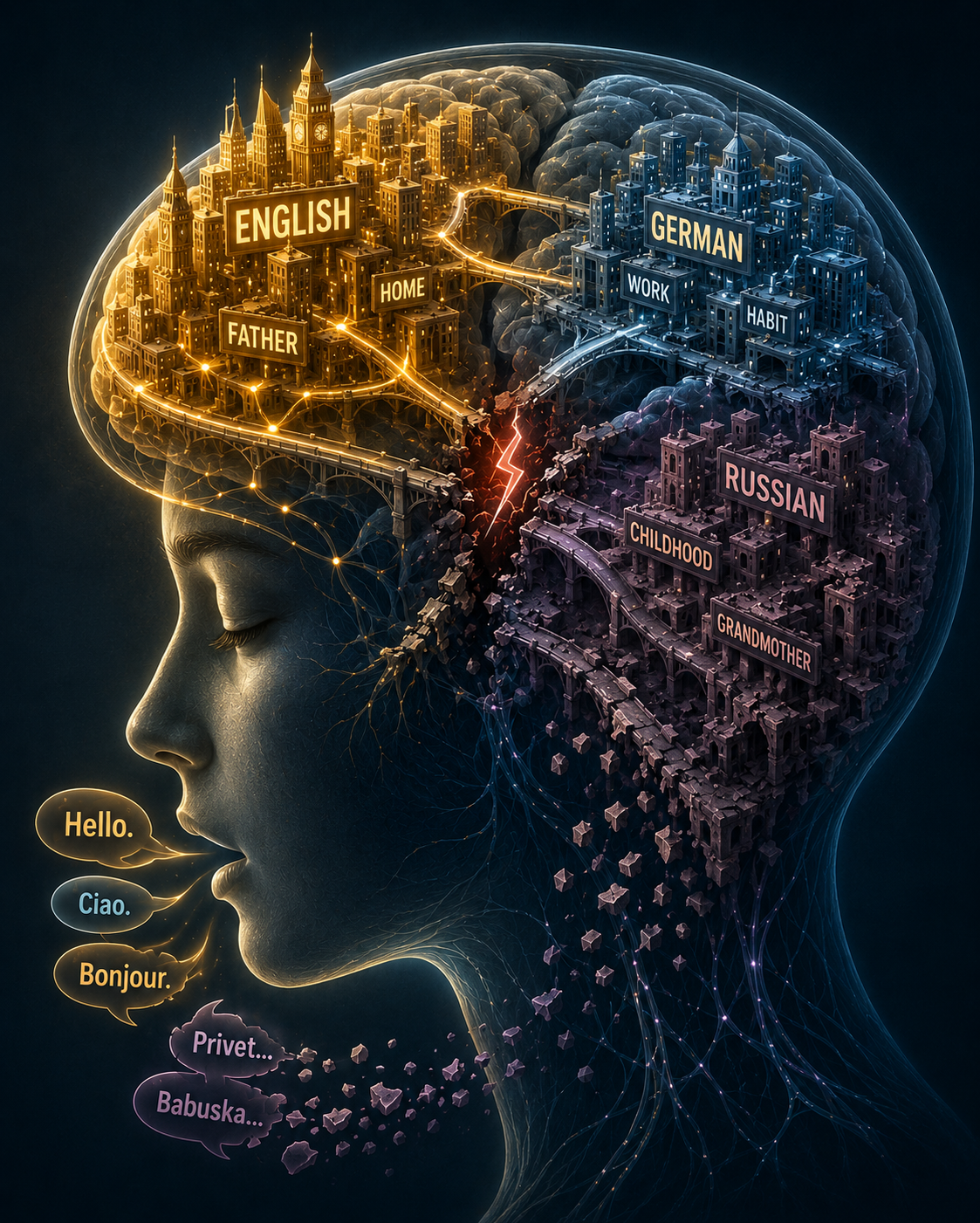
One of the oldest theories in brain science is "Ribot’s Law" which suggests that our oldest memories are the toughest and most resistant to damage (Cezza, 2012; Wixted, 2004). Think of it like a last-in, first-out rule where the most recent language you learned is the most fragile and the first to go (Lorch & Barrière, 2002). For example, a famous case involved a Russian soldier who also spoke French and German fluently. Immediately after his injury, he could only produce speech in his mother tongue, Russian (Lorch & Barrière, 2002).
Usage Over History
But the brain is also about practice, leading to a different theory known as "Pitres’ Rule" (Pearce, 2005). This rule claims that the language you use most often in your daily life is the most likely to survive, regardless of when you learned it (Cezza, 2012). One striking example is Patient EG, whose daily language was Italian. After a stroke, his Italian recovered while his native Slovenian, the language he used least, actually got worse (Cezza, 2012).
How the Brain Designs Its Healing Path
The brain doesn't always follow a straight line when healing. It can choose several different "roadmaps" for language recovery (Cezza, 2012). While "parallel recovery" means all your languages return at the same rate, many people experience "selective recovery" where one language recovers much better than the others (Pearce, 2005). In even rarer cases, "successive recovery" occurs, where the brain waits for one language to be fully restored before it even begins working on the next one (Cezza, 2012). There is even a blended pattern where words and phrases from different languages become mixed together, creating confusion for both the speaker and the listener (Pearce, 2005).
What Decides Which Language Wins?
So why does the brain choose one over the other? Some scientists think it’s about "activation thresholds" which is just a fancy way of saying a language needs a certain amount of mental energy to wake up (Cezza, 2012). Daily practice lowers this threshold, making the most-used language easier for the brain to grab after an injury (Cezza, 2012). In some rare cases, this creates "antagonistic recovery" where one language gets better only as the other one starts to fade away (Pearce, 2005).
While bilingual aphasia shows us how the brain stores multiple languages, other patients reveal that the brain can alter how a language sounds even when the language itself remains intact.
Perhaps the most bizarre phenomenon following brain injury is "Foreign Accent Syndrome" where a patient wakes up sounding like they are from another country (Moen, 2000). While it sounds like magic, it is actually a very specific problem with the brain's motor control or its ability to coordinate speech muscles (Moen, 2000). In a famous 1941 case, a Norwegian woman was hit by a shell fragment and woke up speaking with what sounded like a German accent (Moen, 2000). Although they are still speaking Norwegian, the rhythm, stress and vowel timing change enough that listeners interpret it as German.
The Choreography of Speech
Scientists use acoustic analysis to study the physical properties of these voices, including how long a sound lasts, how high or low the voice sounds and which parts of a word are emphasized (Moen, 2000). They've found that foreign accent syndrome is not a true foreign accent but a change in the melody of speech (Moen, 2000). Even small changes in vowel length or the stress placed on certain words can be enough for listeners to perceive an accent that isn't really there. It's essentially a breakdown in the brain's "choreography" for moving the lips and tongue with perfect precision.
These strange cases teach us that language recovery is a highly personal journey driven by a mix of history, habit and brain wiring. Whether it's the survival of a childhood tongue or the emergence of a new accent, the brain's priority is always to find the pathways that remain most accessible after injury (Pearce, 2005). Every language we learn leaves its own footprint in the brain. When injury disrupts that network, recovery reflects a lifetime of memories, habits and use. By understanding why some words survive while others disappear, scientists aren't just learning how language works; they're learning how the human brain rebuilds itself.
Author: Zeren Kasman
References
Cezza, M. (2012). Recovery patterns in bilingual aphasia: Influential factors & cross-language transfer.
Lorch, M., & Barrière, I. (2002). Pitres’ two remarkable cases: Pure agraphia (1884) and polyglot aphasia (1895). In F. Fabbro (Ed.), Advances in the neurolinguistics of bilinguals: Essays in honour of Michel Paradis (pp. 193–205). Forum Press.
Moen, I. (2000). Foreign accent syndrome: A review of contemporary explanations. Aphasiology, 14(1), 5–15. https://doi.org/10.1080/026870300401577
Pearce, J. M. S. (2005). A note on aphasia in bilingual patients: Pitres’ and Ribot’s laws. European Neurology, 54(3), 127–131. https://doi.org/10.1159/000089083
Wixted, J. T. (2004). On common ground: Jost’s (1897) law of forgetting and Ribot’s (1881) law of retrograde amnesia. Psychological Review, 111(4), 864–879. https://doi.org/10.1037/0033-295X.111.4.864