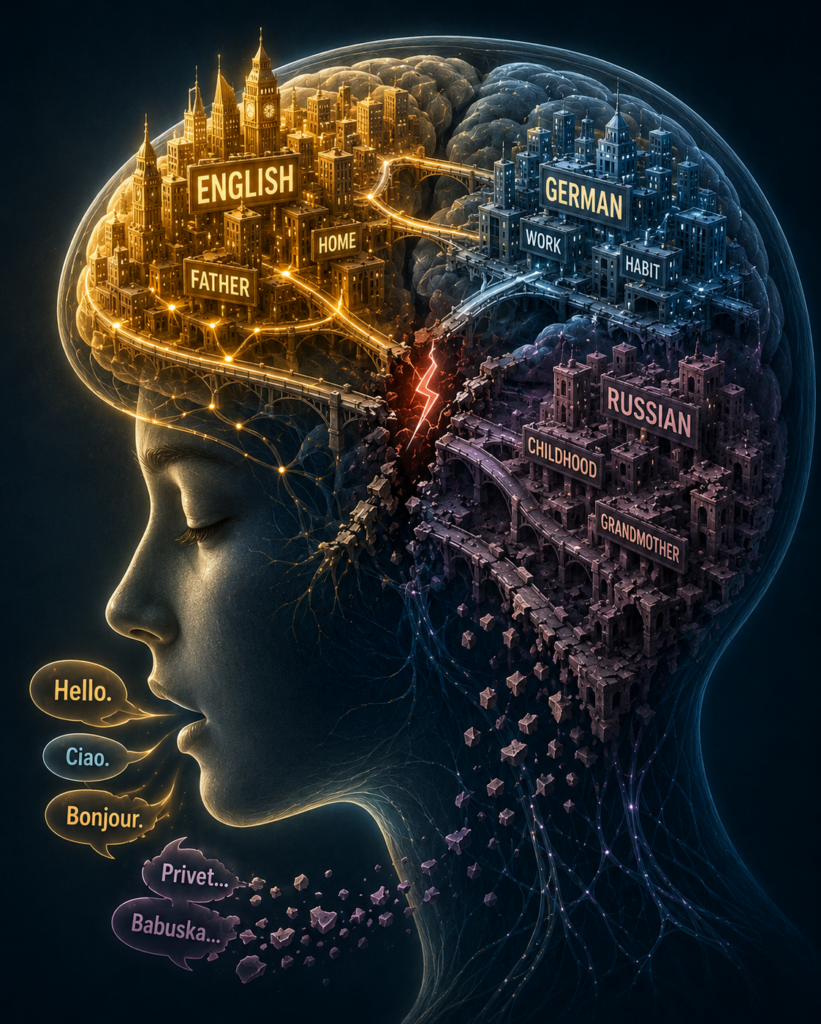
Imagine trying to describe your deepest emotions, but feeling that the words change their meaning depending on the language you use. A phrase that sounds natural and powerful in one language may suddenly feel distant, awkward, or even incomplete in another. The same memory, the same thought, the same feeling - yet somehow expressed differently.
For bilingual speakers, language is more than a simple tool for communication. Each language carries its own rhythm, cultural associations, and emotional weight. As a result, switching languages can sometimes feel like shifting perspectives - not only on what we say, but also on how we feel and understand the world around us.
The brain behind language
Whether you want to consume or create any content, you have to use some language as your tool to do so. Language is a communication system which uses words and systematic rules to organise the information that needs to be transmitted from one individual to another. Therefore, there are two central features to language: the capacity to form signs (words) and the capacity to combine them into more complex structures. A linguistic sign is generally two elements - a meaning and a form, and a link between the two. These structures build a solid base on which we can create whatever message we want to deliver. That is thanks to our phenomenal brain.
Which parts of the brain let us do it? The left temporal lobe is crucial in word finding, language comprehension and processing information, which enables understanding language. The left posterior superior temporal gyrus (Wernicke’s area), the left posterior middle temporal gyrus (pMTG) and underlying white matter are important for lexical activation and phonological processing, which allows us to create statements. The cortex is responsible for speech, thinking, reasoning and learning.
Learning languages has always been an efficient and effective way to self-develop. Being bilingual or multilingual is extremely beneficial for our minds because, in order to maintain any balance between two or more languages, our brain relies on executive functions and cognitive abilities, such as attention and inhibition. It demands constant focus and the ability to keep two or more systems under control, while they all want to be in the centre of attention. This practice strengthens the control mechanisms, which often make bilingual or multilingual people perform better on tasks that require conflict management. They also find it easier to deal with tasks demanding active inhibition or to switch between two different tasks, just like their brains switch between their linguistic tools.
Research has shown increased activation in the dorsolateral prefrontal cortex when using two languages. Language switching has also been found to involve such structures as the anterior cingulate cortex (ACC), bilateral supermarginal gyri, and left inferior frontal gyrus (left-IFG). Not only the activation of certain areas, but also changes in structure have been proven to appear in bilingual brains - researchers have found the enhancement in grey matter volume in the left inferior parietal cortex and in white matter volume as well. The process of learning a language stimulates our brain itself, so it is easier to learn new vocabulary and new things from any field, due to better information processing. It can also slow down cognitive decline and improve our memory by creating new brain networks which replace the ones damaged with ageing.

The language of emotions
Language is not only a tool for communication but also a reflection of cultural experience. Linguists have long argued that the structure and sound patterns of language influence how speakers perceive and categorise the world. Because emotions are deeply embedded in cultural contexts, different languages may encode emotional meanings in slightly different ways. For bilingual speakers, switching languages can therefore activate different emotional associations and cultural frames of reference, shaping how feelings are expressed and interpreted.
Written in two languages, the same story creates a completely different vision, making us feel entirely diverse. However, bilinguals can learn new emotion concepts through immersion in a foreign language and culture, which is crucial for shaping emotional life. Different languages convey various emotional attitudes, reflecting distinct cultural glimpses. Even our tones, the way we sound and pronounce words, change, so it must appear in the emotional influence.
Our second language will always be a bit more distant, which lets us get a little detached from the weight its emotional words carry. On the one hand, it is helpful to express some difficult feelings; on the other hand, it is the first language that is considered to be the language of emotions, because it is harder to hide them when all the words in your head are associated with some cultural contexts. The perception of our native culture and the view of specific emotions being related to particular events, reactions, and feelings is our internal mirror for everything we encounter as we grow and explore languages, cultures and the whole world.
While some people prefer to express emotions in their second language, others find it hard. The cause of difficulties in expressing emotions in the second language may be differences in emotional scripts and vocabulary of the given languages (some words are untranslatable or are “fake friends” - sound similar, but have other meanings), but the better you understand the language, the more fluent you become, also in its emotional codes. The ability to express feelings in a foreign language is linked to the self-perceived proficiency.
Research also suggests that the choice of language when expressing emotions depends on several factors, including proficiency, context, and personal experience. Some bilingual speakers prefer to use a second language when discussing emotionally difficult topics because the emotional intensity associated with words in that language may feel weaker. Others rely on their native language, which is often more strongly connected to early emotional experiences and cultural identity.
Little errors in the system
Expressing feelings in more than one language can be both enriching and complex, but capturing emotions in words can sometimes be challenging. Have you ever had a feeling that something is on the tip of your tongue, but you just couldn’t find the words to express it, even though you know two or more languages? If you’re bilingual, it probably happens to you very often, but you should not worry, because it’s completely normal and has an explanation deep inside your brain, which is fighting its own battles every day, dealing with language. When persistent linguistic competition is happening in the brain, you may experience the frustration of knowing exactly what you want to say but being unable to find the right word. This experience, commonly known as the tip-of-the-tongue phenomenon, occurs when a speaker has access to the meaning of a word but temporarily cannot find its phonological form. In bilingual individuals, this phenomenon may occur more frequently because both linguistic systems are simultaneously active and compete for selection in the brain.
Word finding is a complex neurological process involving several areas of the brain, primarily in the left hemisphere. Research shows that brain areas involved in finding and producing words work together dynamically when we search for a specific word. During bilingual language use, the brain must constantly manage two active vocabularies, which increases the cognitive load associated with selecting the appropriate vocabulary. As a result, the brain sometimes temporarily blocks access to the intended word while suppressing alternatives from another language.
Interestingly, these temporary difficulties do not indicate a weaker linguistic system. Instead, they reflect the brain’s remarkable ability to manage multiple language networks simultaneously. The bilingual mind constantly navigates between two linguistic worlds, selecting words, suppressing alternatives, and adapting to the communicative context. What may appear as a momentary lapse in memory is, in fact, evidence of the complex and dynamic processes that underlie bilingual language use.
The flexible mind - lessons from bilingualism
Bilingualism is far more than the ability to communicate in two languages. It represents a complex cognitive system in which multiple linguistic networks interact within the brain. The constant management of these systems strengthens executive functions such as attention, inhibition, and cognitive flexibility, while also reshaping neural structures involved in language processing.
At the same time, languages are deeply connected to emotional experiences and cultural contexts. Because of this connection, bilingual speakers may perceive and express emotions differently depending on which language they use. A first language often carries stronger emotional resonance, while a second language may create a sense of psychological distance that can either facilitate or complicate emotional expression.
Although bilingual speakers may occasionally experience difficulties such as temporary word-finding problems, these moments are a natural consequence of the brain’s effort to manage multiple linguistic systems. They demonstrate the remarkable flexibility and adaptability of the bilingual mind. Ultimately, bilingualism allows individuals to navigate the world through multiple linguistic and cultural perspectives, enriching both cognitive processes and emotional experience.
Author: Ewelina Tymińska
References
Riès, S. K., Dronkers, N. F., & Knight, R. T. (2016). Choosing words: Left hemisphere, right hemisphere, or both? Perspective on the lateralisation of word retrieval. Annals of the New York Academy of Sciences, 1369(1), 111–131. https://doi.org/10.1111/nyas.12993
Bouchard, D. (2015). Brain readiness and the nature of language. Frontiers in Psychology, 6, 1376. https://doi.org/10.3389/fpsyg.2015.01376 PMCID: PMC4563876
OpenStaxCollege. (2014). Language (w rozdziale Thinking and Intelligence). W Psychology. Pressbooks. https://pressbooks-dev.oer.hawaii.edu/psychology/chapter/language/
Neurotorium. (2024). Key cortical language processing regions in the brain [Image]
Marian, V., & Shook, A. (2012). The cognitive benefits of being bilingual. Cerebrum, 2012(13). https://www.ncbi.nlm.nih.gov/pmc/articles/PMC3583091/
Ożańska-Ponikwia, K. (2012). Emotional expression in a foreign language. What factors influence the choice of a non-native language while expressing emotions. Linguistica Silesiana, 33, 203–219. https://journals.pan.pl/Content/89122/mainfile.pdf
Edward Sapir. (1925). Sound patterns in language. Language, 1(1), 37–51. https://doi.org/10.2307/409004
Dylman, A. S., Champoux-Larsson, M.-F., & Zakrisson, I. (2020). Culture, language and emotion. Online Readings in Psychology and Culture, 4(2). https://doi.org/10.9707/2307-0919.1167