Often, when people talk about aging, they focus on its prevention through external means. With the amount of anti-age beauty treatments being advertised to us with the pretense that they can “make us look 20 years younger” or “remove all of our wrinkles in two weeks”, it is no surprise that the process of aging most often has a negative connotation. However, there are more important things to focus on aside from our physical appearance throughout aging, and that is our health. And while aging does indeed bring about negative changes that may lead to decreased health, quality of life and wellbeing, these changes are not as inescapable as they may seem.
The most important aspect of living healthily amidst aging involves keeping your brain healthy. You may think of your brain as the headquarters of functioning of all other parts of your body, as well as your thoughts and views of yourself and others. With such an important role, this management and executive system is the key target in preventing unwanted age-related changes.
So, how can we actually take care of the brain despite the changes brought about by aging?
What happens to the brain as we age?
Throughout the lifespan, the brain undergoes vast structural and functional changes and these changes are unique for every person based on their learning and life experiences. This concept, referred to in neuropsychology as neuroplasticity, is what ultimately defines the outcome of our functioning in old age. So, simply put, the healthier our life experience is, the more dense and strong our brain connections will be, and the better our functioning and well-being will be once we reach older age.
Some of the most prominent brain changes occurring throughout life are changes in the amount and density of gray and white matter. While gray matter encompasses specific parts of the brain with specific functions, white matter is responsible for the communication between these brain areas. As one ages, their gray and white matter deteriorate due to various aspects such as wear and tear, lack of (efficient) use of certain brain functions, or neurotoxicity (damage to the brain caused by external sources like drugs and radiation, or internal such as abnormal protein accumulation (neurofibrillary tangles and amyloid plaques) in the brain). All these factors eventually lead to visible functional deficits common in old age and could lead to Alzheimer's disease. Deficits most often involve problems with attention, memory, and inhibition of unwanted cognitive and motor actions.
Influencing Factors: Why is it important to develop resilience as we age?
Although aging is natural, there are several influencing factors that may accelerate this process and negatively affect its outcome, highlighting the need to develop healthier habits and establish resilience.
In general, being overweight and having a poor metabolism related to poor dietary choices affect a large part of the population over 60 years of age and have important negative effects on aging and the development of age-related brain disorders. Specifically, obesity and hyperlipidaemia (increased lipid concentration in the blood) are associated with an increased risk of cognitive decline and dementia later in life. Poor eating habits, an unhealthy body weight and a sedentary lifestyle are also risk factors for hypertension (chronic high blood pressure) which in turn increases the risk of cognitive impairment with age. Specifically, diets high in calories, fat and carbohydrates increase the aforementioned risks and may contribute to the development of age-related cognitive decline.
Low intellectual engagement is another influencing factor when it comes to cognitive decline. In the context of neuroplasticity, one principle related to this process is “use it or lose it” and it states that brain functions that are used repeatedly will be enhanced and their quality maintained, while functions that are not used will deteriorate. Therefore, lower intellectual engagement and reduced engagement in problem-solving activities may lead to poorer cognitive performance in older age.
Chronic depression and anxiety (negative affect) also have an influence on the aging process. Prolonged anxiety negatively affects the functioning of the hypothalamic-pituitary-adrenal axis (HPA axis), and abnormal functioning of this network in turn may contribute to age-related depression, cognitive deficits and Alzheimer’s disease. Psychological research has linked depression to mild cognitive impairment and dementia. More specifically, a prolonged depressive period may have neurotoxic effects on the brain, leading to inflammation and degradation of the functioning of certain areas. Generally, depression and anxiety decrease wellbeing, which further exacerbates their negative effects on cognitive functioning throughout the lifespan.
Cognitive Resilience comes in many forms: Reserve, Maintenance, Compensation
Reserve is defined as the collection of mental resources that is developed prior to the start of aging that mitigates the effects of neural decline caused by the aging process. These mental resources are acquired during the lifespan in the form of knowledge, abilities and skills. Such resources can be enhanced through education as well as gaining expertise in a particular domain or skill through training. Reserve is used to enhance neural resources beyond their current level and depends on genetic and environmental factors, as well as the level of maintenance of current functioning. Having a large cognitive reserve allows for a more efficient and more densely connected neural network, therefore preventing age-related cognitive decline.
Maintenance is our ability to preserve our resources (reserve) through continuous dynamic replenishing and repair of the brain in response to functional degradation resulting from wear and tear. This process becomes more critical as we reach older age due to increasing deterioration of neurons and neural networks. An example of maintenance is reading books frequently, and this activity allows one to maintain attention and memory ability. The effectiveness of maintenance depends on neural processes which are influenced by both genetic and environmental factors.
Compensation refers to the extent to which people enhance the recruitment of neural resources in response to high cognitive demand, which leads to improved performance. People may compensate by using the same brain regions to complete a certain task while increasing their activity beyond their usual level, or using different brain areas from the ones normally used to complete the same function. An example of compensation, in the instance of damage to Broca’s area (responsible for speech production), is when structures surrounding this area start to take over its function of producing speech. Although compensation is a tool used naturally to perform a task better, it does not necessarily promote healthy brain functioning and optimized task performance and is rather a response to damage that has already occurred.
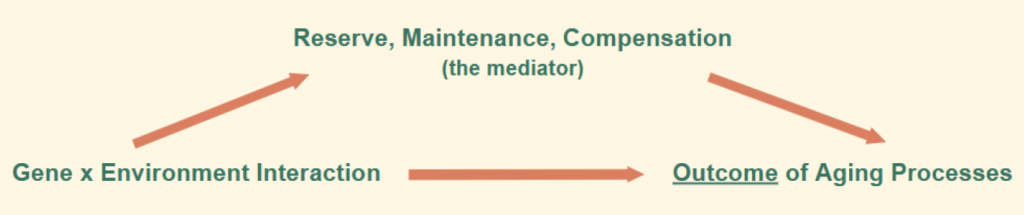
Overall, reserve, maintenance and compensation mediate the gene x environment interaction responsible for aging processes and form a major reason why there is large inter-individual variability when it comes to cognitive aging. As mediators, they influence the interaction of one’s genetic makeup and their environment (life events) with the aging process. This relationship could yield positive or negative age-related outcomes. The point is that in the same way we can negatively influence our brain health, life and functioning outcomes, we can also use various strategies to cultivate a healthy environment for our brain to function optimally and keep us happy and healthy for longer.
Turning knowledge into action: what kinds of activities can help improve brain health?
Despite popular belief, keeping your brain healthy does not require specialized protocols or expensive treatments. Most activities are affordable, easy and good for your brain and body.
What is good for the body is good for the brain!

One of the most important strategies to enhance and maintain brain health is physical activity. While habitual exercise improves cardiovascular health and fitness, it has also been found to improve memory and cognitive processes and increase wellbeing through its analgesic (pain-relieving) and anti-depressant effects. Therefore, incorporating physical exercise into your weekly routine may greatly benefit both your physical and mental health and delay the aging process, also reducing the risk of maladaptive aging. Important to note is that, while habitual exercise has vast positive effects, too much exercise and exercise that goes beyond one’s physical ability instead has a damaging effect on the body. Thus, one must develop a routine that is tailored to their needs and capabilities.
A second consideration involves nutrition. Research has shown that a diet focusing on whole foods, amino acids, B group vitamins, vitamins C, D and E as well as minerals has a protective effect on the nervous system. Following a balanced diet benefits neurotransmitter production in the brain and reduces age-related cognitive decline as well as preventing the risk of developing a neurodegenerative disorder. Diets rich in antioxidants and anti-inflammatory components promote a healthy gut microbiome and healthy functioning of the microbiota-gut-brain axis. This communication between the gut and the brain regulates neurotransmitter production and is essential in maintaining cognitive functioning during aging.
Intellectual stimulation and Sleep
An essential strategy of delaying age-related decline is continuous cognitive engagement. Academic literature has found that increased years of education are associated with higher levels of cognitive reserve, meaning that people who have the opportunity to learn for many years have more knowledge and skills, which translates into protective factors against cognitive decline. It is important to mention that one’s level of education from schools and universities heavily depends on factors such as opportunity, geographic location, quality of education and financial ability. However, learning does not have to depend on an educational institution or end after graduation. Cognitive reserve can be enhanced even in older age, and this can be done by making learning new things an active part of one’s life. Learning regularly through reading articles, practicing new skills like cooking or playing an instrument, or even simply broadening a skill you already have (trying new recipes if one is a skilled chef), would allow you to increase your cognitive reserve capacity and drive positive neuroplastic processes. This would in turn help maintain a healthy brain environment.
A less obvious but crucial method of improving brain health is sleep. Generally, sleep promotes homeostasis and allows for tissue repair and regrowth, as well as strengthening of the immune system. Even though difficulty initiating and maintaining sleep and insomnia are common issues in older age, a chronic lack of sleep has been found to increase the risk of age-related pathology like Alzheimer’s disease. Having a regular and sufficient sleep schedule may add to the effects of intellectual stimulation, as it allows for improved memory consolidation (storing of memories in the brain) and emotion regulation, as well as improved processing of emotional information and memory. As sleep promotes both physical and brain health, having a consistent sleep schedule is strongly recommended.
Taking care of your mental health
Your mental health provides an equally important contribution to brain health as does improving your physical health and intellectual engagement. One way of taking care of your mental health involves meditation, an activity focused on promoting self-regulation and focused attention with the goal of reaching mental clarity and a calm state. In clinical populations, this method is frequently used to enhance wellbeing and diminish the negative effects of disease symptoms. Though its initial effects are primarily emotion-related, repeated practice over a longer period of time may have the potential to increase neuroplasticity of the brain, allowing brain regions to “rewire” themselves to have more efficient functioning. While research-based evidence about neural changes from meditation is scarce, a larger body of research supports the effectiveness of meditation when it comes to improving mood and wellbeing.
Mental health could also be improved by spending time doing leisure activities. Leisure activities are heterogeneous in terms of their level of physical activity, cognitive effort and social exposure. However, they have in common the fact that people may engage in them to improve their psychological functioning, distract themselves from daily life stressors and get entertainment. Such activities may be solitary reading, word and number games including crossword puzzles, card games and chess. Reading is associated with a lower risk of depression, lower feelings of loneliness and increased sense of meaning in life, with more frequent reading having larger effects. More demanding leisure activities like word, number and mind games may lower the risk of depression and increase energy levels, however, overexposure to these kinds of activities leads to negative effects like stress (especially if the game is competitive), so engaging in them in moderation is preferred.
How do we sustain healthy practices?
Resilience practices to prevent the negative effects of aging should be started early. As there is currently no “cure” for impairments caused by aging, implementing the above-highlighted brain health activities in the earlier stages of life would place the focus on the prevention of later pathological changes. Therefore, it is crucial for people to start taking care of their brain health as early as possible in order to significantly lower their risk of pathological aging and promote healthy aging processes.
The ideal way to develop and maintain resilience should begin by taking small steps. Completely turning one’s life around overnight is not feasible and can be quite overwhelming. Therefore, starting small by implementing one positive practice into your daily routine would be ideal. For example, you may not be able to incorporate a high-impact workout session into your schedule for 3 days a week right away, but you may be able to start with a less intense activity such as taking a long walk, going for a run or doing yoga for one day a week.
A second point of consideration involves consistency. Successful implementation of healthy habits requires proper scheduling. By creating and following a routine, you would allow time to use the brain health strategy you choose to implement while also having time for all other life obligations. Schedules further allow for setting deadlines and increased feelings of accountability and motivation to get things done, which would aid the process of constructing a healthier lifestyle.
Another useful method is to incorporate community into your practices. This may include doing physical activity with a friend or family member, having a study buddy to keep each other accountable while learning together, or creating a call schedule with someone close to you with whom you could discuss your progress and motivate each other to keep going. By including loved ones into these activities, you may greatly increase your adherence and motivation to improve your brain health.
Aside from methods to enhance active participation as detailed above, a related strategy is listening to your body. In order to maintain an active and healthy lifestyle, listening to yourself and knowing when something is too much or not effective is of utmost importance. As only you know what activities and how much benefits you, it is necessary to balance the motivation to do more with the reality of your ability and need. Wellbeing is just as important as progress.
Conclusions and Suggestions
Aging is an inevitable process that impacts the entirety of the human population. However, by understanding the core molecular and behavioral mechanisms and implementing strategies to improve our brain health, we can delay the cognitive decline that comes with the aging process and improve our quality of life. By implementing these aforementioned methods, we would be able to foster and sustain a brain-healthy lifestyle which would keep us healthy and happy for much longer.
While this article provides science-backed methods of increasing and maintaining brain health, it is by no means exhaustive, and the reader is encouraged to consult other sources (provided below under “References”) and do their own research in order to deepen their understanding of the complex process of aging.
Author: Nika Murganic
References:
Cabeza, R., Albert, M., Belleville, S., Craik, F. I. M., Duarte, A., Grady, C. L., et al. (2018). Maintenance, reserve and compensation: the cognitive neuroscience of healthy ageing. Nature Reviews Neuroscience, 1–10. doi: 10.1038/s41583-018-0068-2
Christie, G. J., Hamilton, T., Manor, B. D., Farb, N. A. S., Farzan, F., Sixsmith, A., Temprado, J.-J., & Moreno, S. (2017, November 20). Do Lifestyle Activities Protect Against Cognitive Decline in Aging? A Review. Frontiers.
Ebaid, D., & Crewther, S. G. (2020). Time for a Systems Biological Approach to Cognitive Aging?-A Critical Review. Frontiers in aging neuroscience, 12, 114. doi: 10.3389/fnagi.2020.00114
Fekete, M., Szarvas, Z., Fazekas-Pongor, V., Feher, A., Csipo, T., Forrai, J., Dosa, N., Peterfi, A., Lehoczki, A., Tarantini, S., & Varga, J. T. (2022, December 22). Nutrition Strategies Promoting Healthy Aging: From Improvement of Cardiovascular and Brain Health to Prevention of Age-Associated Diseases. MDPI.
Gupta, D., & Morley, J. E. (2014, October 1). Hypothalamic-Pituitary-Adrenal (HPA) Axis and Aging. Wiley Online Library.
Herrman, H., Stewart, D. E., Diaz-Granados, N., Berger, E. L., Jackson, B., & Yuen, T. (2011, May 1). What is Resilience?. SageJournals.
Leitão, C., Mignano, A., Estrela, M., Fardilha, M., Figueiras, A., Roque, F., & Herdeiro, M. T. (2022, January 27). The effect of nutrition on aging-A systematic review focusing on aging-related biomarkers. MDPI.
Liegro, C. M. D., Schiera, G., Proia, P., & Liegro, I. D. (2019, September 17). Physical Activity and Brain Health. MDPI.
Mather, M., & Harley, C. W. (2016). The locus coeruleus: Essential for maintaining cognitive function and the aging brain. Trends in Cognitive Science, 20, 214–226
Melzer, T. M., Manosso, L. M., Yau, S., Gil-Mohapel, J., & Brocardo, P. S. (2021, May 10). In pursuit of healthy aging: Effects of nutrition on brain function. MDPI.
Patel, A. K., Reddy, V., Shumway, K. R., & Araujo, J. F. (2024). Physiology, sleep stages. In StatPearls [Internet]. StatPearls Publishing. Porricelli, D., Tecilla, M., Pucci, V., Rosa, E. D., Mondini, S., & Cappelletti, M. (2024, July 2). Cognitive reserve modulates mental health in adulthood. SpringerLink.
Staff, R. T., Hogan, M. J., Williams, D. S., & Whalley, L. (2018, November 20). Intellectual engagement and cognitive ability in later life (the “use it or lose it” conjecture): Longitudinal, prospective study. BMJ.
Walker, M. P. (2009, March 25). The role of sleep in cognition and emotion. Annals of the New York Academy of Sciences, 1156(1), 168-197.
Wendołowicz, A., Stefańska, E., & Ostrowska, L. (2018). Influence of Selected Dietary Components on the Functioning of the Human Nervous System. ResearchGate.
Weziak-Bialowolska, D., Bialowolski, P., & Sacco, P. L. (2023, February 17). Mind-stimulating leisure activities: Prospective associations with health, wellbeing, and longevity. Frontiers.