Day of the accident
It’s 10 o’clock on a Thursday night and Emma is driving home from a family dinner. The night air feels thick and heavy as she slowly moves through the streets of her hometown. It’s one of those late-autumn evenings when the darkness seems deeper than usual. The road ahead is mostly empty, and streetlights are placed scarcely. She turns up her favourite song and starts to sing, tapping her fingers on the steering wheel. For a moment everything feels calm and familiar. At the crossroads she slows down and glances both ways. Nothing. She steps on the gas and slowly starts driving.
Suddenly, she notices a bright light appear as if from nowhere. She turns her head and sees a short flash of yellow approaching her at a crazy speed. She barely has the time to collect her thoughts before the impact comes.
A yellow sedan crashes into her side with a great force. Her body jolts sideways, head striking the door. In this split second between silence and chaos, Emma’s mind freezes. Not from thought, but from instinct.
Inside her brain, an ancient alarm system takes over. Before Emma can form a thought, all sensory information, such as the light, the noise and the pain are routed through the thalamus. From there, it is sent along two paths at once: directly to the amygdala and, more slowly, to the prefrontal cortex (PFC). The amygdala does not wait. It identifies the situation as life-threatening and activates the hypothalamus, which immediately switches on the sympathetic nervous system.
Adrenaline is released. Emma can feel her heart race, her breath quicken, and her muscles tense up, as vessels dilate and her blood rushes. All of this happens within a second, entirely outside her conscious awareness.
Within minutes, a second system turns on. The hypothalamic-pituitary-adrenal (HPA) axis begins releasing cortisol, mobilising energy and reshaping how the brain processes the moment. Activity in the hippocampus and the amygdala increase, strengthening emotional and sensory memory encoding, while rising stress hormones suppress the PFC. She could not possibly make a rational decision or plan any elaborate action at this moment. Instead, her subcortical survival system takes control, producing automatic responses like screaming or freezing.
After the impact, Emma’s body starts to shake. She feels nauseous. Then, as the immediate threat passes, her nervous system shifts again. Parasympathetic activity increases, heart rate slows, and sensation dulls. Numbness and dissociation set in. Not because the danger is gone, but because her brain is trying to protect her, by making her feel disconnected from her body and her overwhelming emotions. By distancing herself from the present moment she feels calmer, and her memories of it will feel less real and less intense in the future.
A few weeks later
Emma is sitting at a café, looking out the window, and waiting for a friend to arrive. She’s sipping on her third cappuccino of the day, fuelling on caffeine helps her function after another sleepless night. She had nightmares again and struggled to fall back to sleep. She puts her fingers to her forehead hoping for the paracetamol to start working soon. The headache just won’t go away. Finally, her friend arrives and Emma gets distracted from the pain and fatigue with a conversation. They talk, sipping on their coffees. Emma tells her friend about a very cute dress she saw in a shop window when she was walking to the café this morning. It was a half hour long walk, but Emma hasn’t set foot in a car since the accident. She sighs and looks out the window.
Suddenly, she cannot hear what her friend is saying anymore. Her heart starts beating like crazy, her head starts pounding and her stomach ties into a knot. Even though she doesn’t choose it, her eyes lock onto a yellow sedan moving slowly down the street. Her amygdala fires, retrieving the stored fear network. The hippocampus fails to place the image safely in the present. To her brain, this is not a memory. Her body is in the car again, reliving the accident. Not as a thought, but as a physical state.
She grips the arms of the chair and her breathing turns shallow and fast. Adrenaline surges. Her muscles tense up. Somewhere, her friend is saying something and trying to help but Emma’s PFC turns off. All she can hear is her own pulse, loud and insistent in her ears. The moment lasts a few seconds, but to Emma it feels like hours.
Finally, the yellow sedan passes and disappears from Emma’s view. The immediate threat is gone, but her body is still flooded with stress hormones. She gets up and rushes to the bathroom. She splashes cold water on her face and sits on the floor, with her head between her legs and tries to breathe slowly. After a moment, the fog lifts. Her heart rate begins to fall and the shaking eases.
Emma stands up and looks at herself in the mirror. Her eyes are still wide, still searching. It cannot continue like this. She realizes she needs help.
4 months after the accident
Emma is looking around her therapist’s office. It’s already her seventh session and she has become familiar with the place. The big comfy armchairs, dim lights, and a huge monstera in the corner feel safe and comforting.
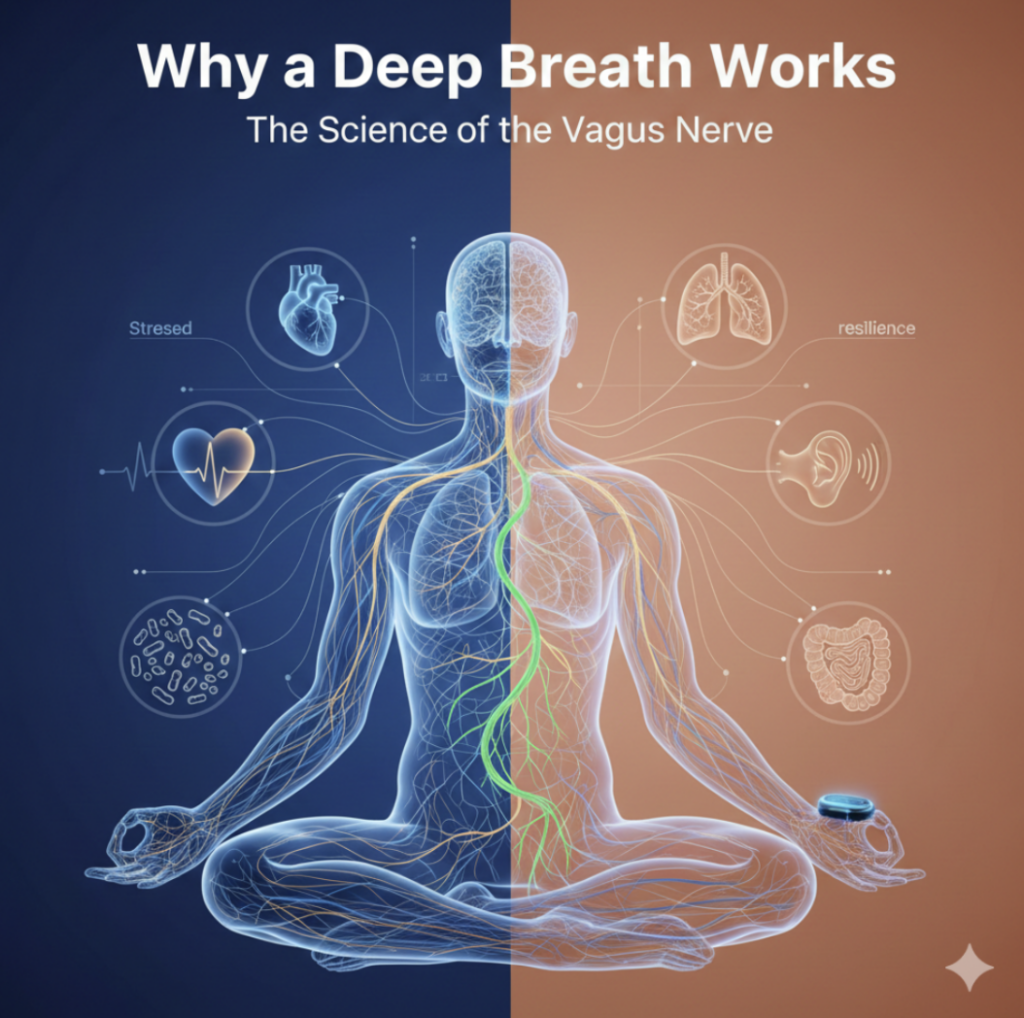
Today, they start by revisiting the accident again to practice telling the story in a controlled way. A few sessions ago her body would still experience extreme distress, but not today. Her therapist guides her gently to slow her breathing and keep her present and grounded. With each breath, her system calms down and prevents the flood of adrenaline.
Emma closes her eyes and tries to describe the yellow sedan. She is calm and her PFC, previously suppressed, is now helping her to think clearly through the moment. She can still feel her stomach knotting up, but she knows she is safe. Each time they repeat this exercise, there is a new memory network strengthened, telling her brain that the car is no longer a threat. Over these past few weeks her hippocampus learned that the accident is just a situation from the past, not something happening in this moment. Her nightmares have gone away and flashbacks don’t come as often anymore. She even let her mum drive her to the therapist's office today.
Her therapist asks her to pay attention to sensations in her body. To notice the pounding heart and tension in her shoulders. By paying attention to the somatic symptoms (and not judging them) she engages cortical control over them. She hasn’t had a headache in over a month now and feels more energised during the day.
By the end of the session Emma feels good. Her breathing is steady and the tension is easing. She opens her eyes and looks around the office. The space feels neutral and ordinary. The brain circuits that once hijacked her body now follow her reasoning instead of dictating it. She realises she can even encounter direct reminders, such as a yellow sedan passing outside, without being consumed by the past.
For the first time in months, Emma feels a sense of agency over her own reactions. She now can see that even after what seemed like the end of the world, the brain can learn, heal, and reclaim control.
Author: Zuzanna Kotwicka
References
Arnsten, A. Stress signalling pathways that impair prefrontal cortex structure and function. Nat Rev Neurosci 10, 410–422 (2009).
Bremner J. D. (2006). Traumatic stress: effects on the brain. Dialogues in clinical neuroscience, 8(4), 445–461.
Cao, M., Zhu, S., Tang, E., Xue, C., Li, K., Yu, H., ... & Deng, W. (2025). Neural correlates of emotional processing in trauma-related narratives. Psychological Medicine, 55, e33.
Foa, E. B., Hembree, E. A., & Rothbaum, B. O. (2007). Prolonged exposure therapy for PTSD: Emotional processing of traumatic experiences: Therapist guide. Oxford University Press.
Konrad, A. C., Miu, A. C., Trautmann, S., & Kanske, P. (2025). Neural correlates and plasticity of explicit emotion regulation following the experience of trauma. Frontiers in Behavioral Neuroscience, 19, 1523035.
Pitman, R. K., Rasmusson, A. M., Koenen, K. C., Shin, L. M., Orr, S. P., Gilbertson, M. W., Milad, M. R., & Liberzon, I. (2012). Biological studies of post-traumatic stress disorder. Nature reviews. Neuroscience, 13(11), 769–787.
van der Kolk, B. A. (2014). The Body Keeps the Score: Brain, Mind, and Body in the Healing of Trauma. Viking.Yehuda, R., Giller, E. L., Southwick, S. M., Lowy, M. T., & Mason, J. W. (1991). Hypothalamic-pituitary-adrenal dysfunction in posttraumatic stress disorder. Biological psychiatry, 30(10), 1031–1048.