Mini brain grown from body cells can now play Pong
To grow, the embryonic brain does not need a building plan; it organizes itself. In 2013, scientists managed to mimic the first few weeks of that process in the lab. Their research shows how body cells in a dish can grow into a brain-like organ.
To grow a mini-brain, proceed as follows. Take a few body cells, for example from the skin, a bioreactor, nutrients and a special support gel. First you make the cells think they are embryonic stem cells, which are cells that can still specialize into a certain type of cell, including nerve cells for example. You do this by activating a specific piece of DNA from these cells. Then you administer growth factors (for example, certain proteins) that promote the development of brain tissue. And voilá: the cells specialize into neuroectoderm tissue that, in an embryo, eventually grows and develops into the central nervous system.
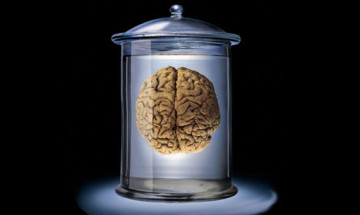
Magnifying glass
The next step is to use the support gel to help the ectoderm develop into a spatial structure. Run the whole thing in the bioreactor for a while and after about a month, a tiny brain will have formed. You do need a magnifying glass to see the result clearly, because it doesn't get any bigger than 2 to 3 millimeters.
The research team from Austria and the United Kingdom used proteins with fluorescent properties to make visible which cell types had formed where. However minuscule; the mini-brain had already begun to form individual brain regions such as the cortex, something akin to a hippocampus and, in some cases, retinal tissue. In addition, the cortex also already showed initial differentiation into layers, and the beginnings of the formation of the various lobes could be seen.
The brain organization also showed some typical human traits such as the relatively strong development of cortex tissue, and these brains made in glass even appeared to function. At least, the researchers saw that the neurons sent electrical currents through their axons that allowed them to communicate with their neighbors.
That was the state of affairs in 2013. In late 2022, a major step forward was made in the world of neurons on petri dishes. Scientists in Australia managed to get a mini-brain consisting of cortical mouse embryo cells to play Pong. For those unfamiliar with the game, it's similar to Pingpong; you control a "paddle" (a rectangle) to rebound a virtual ball against a wall. When you miss the bouncing ball, you are finished.
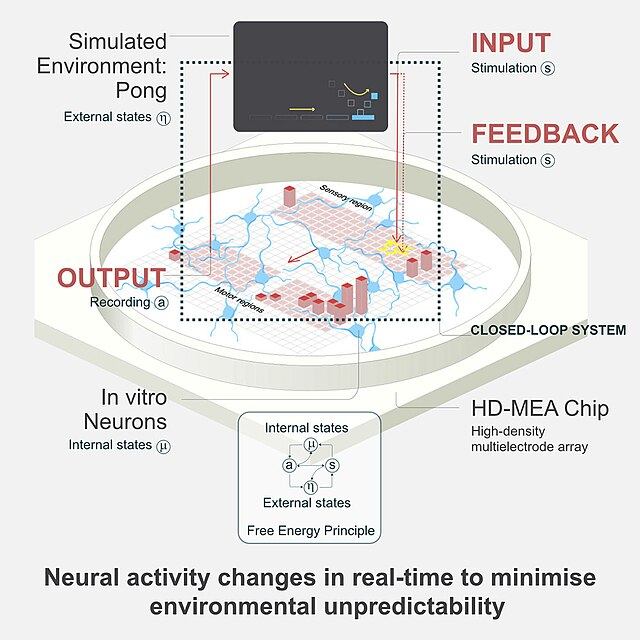
The mini-brain in this experiment consisted of 800,000 cells whose activity could be regulated and measured via electrodes. One part of the neurons was the sensory region, which received the location of the ball and bat. The other part represented the motor region, which could provide output to control the bat. It was a closed-loop system, giving the system instant feedback on whether it was doing it right or wrong. Every time the mini-brain missed the ball, it received random electrical signals. This was interpreted as a kind of punishment by this artificial brain. After all, it doesn't like getting unpredictable input. When it managed to hit the little ball, it received predictable input (all sensory electrodes were activated at the same time), which was interpreted as a reward. Within 5 minutes, the mini-brain had figured out the purpose of the game.
Just for nuance, The group of neurons did not play pong at top level, but rather above chance level. However, this does mark the first time cells in a petri dish have accomplished goal-directed tasks. Because this was thought impossible until recently, it has led to much debate in science. Does this group of neurons now have a form of consciousness? What ethical implications would that have? And could this way of learning have implications for artificial intelligence? Scientists and ethicists haven't decided yet. We're curious what you think!
Authors: Daan Schetselaar, Pauline Gils & Joyce Burger
Image and Text Reference:
- Kagan, Brett J. et al. 2022. In vitro neurons learn and exhibit sentience when embodied in a simulated game-world. Neuron, Volume 110, Issue 23, 3952 - 3969.e8